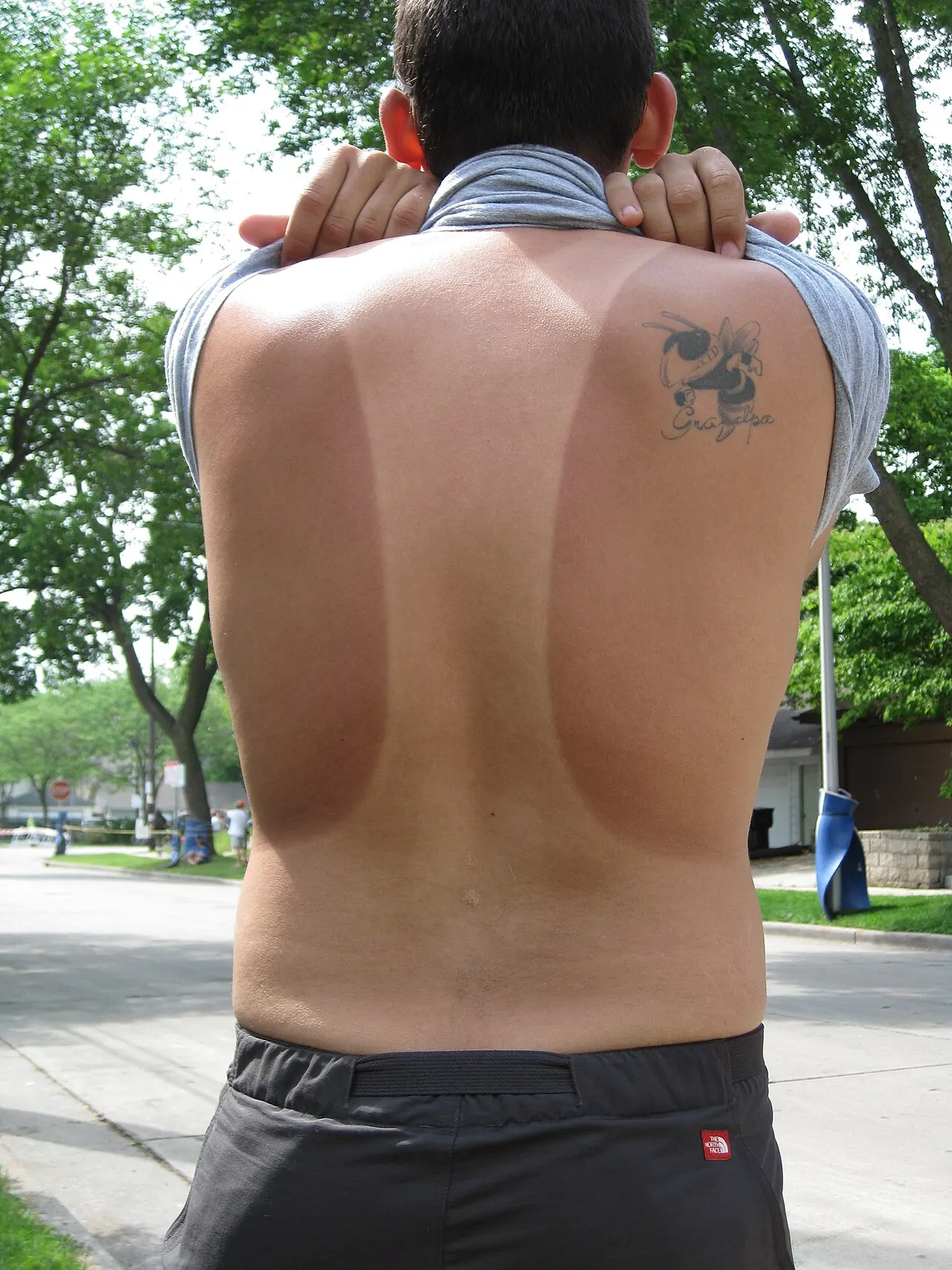
Everyone who has spent a day outdoors in a vest top or a pair of shorts knows the result: crisp, clearly defined lines where tanned skin meets pale skin. Tan lines are one of the most visible signs of sun exposure, and while some people wear them proudly, others find them frustrating — especially when they clash with a different outfit the next day. Understanding why tan lines form, how sharp they become, and what actually works to soften them puts you in a much better position to manage your time in the sun.
How Tan Lines Form: The Melanin Response
Tan lines are the direct result of uneven UV exposure across your skin. When ultraviolet radiation — particularly UVB — reaches the epidermis, it triggers a process called melanogenesis. Specialised cells called melanocytes respond to UV-induced DNA damage by producing more melanin, the brown-black pigment that gives skin its colour. This melanin is then distributed into surrounding keratinocytes, darkening the skin as a protective response.
The key point is that this process only happens where UV actually reaches the skin. If a strap, waistband, or piece of fabric is blocking UV from a patch of skin, the melanocytes in that area receive no signal to produce extra melanin. The result is a sharp boundary — tanned skin on one side, pale skin on the other — because UV radiation is essentially binary at the edge of a piece of clothing: it either reaches the skin or it does not.
This is why tan lines are so precisely defined. Unlike a gradient or a soft fade, the transition happens over just a few millimetres at the fabric edge. There is no significant scatter or diffusion of UV under the clothing, so the melanin response stops abruptly where the coverage begins.
How Much UV Gets Through Clothing?
Not all clothing blocks UV equally. The amount of UV that passes through fabric depends on three main factors: weave density, fibre type, and colour. This directly affects how visible your tan lines will be.
| Fabric type | Typical UPF | UV transmission | Tan line sharpness |
|---|---|---|---|
| White cotton T-shirt | ~5 | ~20% passes through | Softer — some tanning occurs underneath |
| Dark cotton T-shirt | ~15–20 | ~5–7% passes through | Moderate |
| Polyester (light) | ~12–30 | ~3–8% passes through | Moderate to sharp |
| Polyester (dark/dense) | ~50+ | <2% passes through | Very sharp |
| Dedicated UPF 50+ clothing | 50+ | <2% passes through | Very sharp |
| Denim | ~1,700 | Near 0% | Extremely sharp |
A standard white cotton T-shirt offers roughly UPF 5, which means about 20% of UV radiation still reaches the skin beneath it. That is why you can sometimes see a faint tan developing under a thin white top. In contrast, polyester typically provides 3 to 4 times the UV protection of cotton with a similar weave, and dark, tightly woven fabrics can block over 98% of UV.
This explains why some tan lines are sharper than others. A loose, light-coloured linen shirt will produce softer, more blended lines than a pair of dark lycra shorts or a thick sports bra strap.
Why Tan Lines Are So Stubborn
Once a tan line has formed, it can take 4 to 8 weeks to fade — and in some cases even longer. The reason lies in your skin's natural renewal cycle.
Your epidermis replaces itself from the bottom up. New keratinocytes are produced in the basal layer and gradually migrate upward over the course of 28 to 30 days in younger adults. In older adults, this cycle slows to 45 to 50 days. As the melanin-loaded cells from your tanning sessions reach the surface and are eventually shed from the stratum corneum, the tan fades.
But here is the catch: if you continue wearing the same clothing in the same position during subsequent sun sessions, you keep reinforcing the same melanin pattern. The exposed areas get darker while the covered areas stay pale, making the contrast even more pronounced over time. The tan line does not just persist — it deepens.
Factors that affect how long tan lines last
- Age — slower cell turnover in older skin means tan lines linger longer
- Fitzpatrick skin type — darker skin types (IV–VI) produce more melanin and hold a tan longer
- Moisturisation — well-hydrated skin sheds cells more evenly, helping lines fade faster
- Exfoliation habits — regular gentle exfoliation accelerates the removal of pigmented dead cells
- Continued UV exposure — ongoing sun sessions in the same clothing keep reinforcing the line
How to Minimise Tan Lines
You cannot completely prevent tan lines if you are wearing any clothing in the sun — but you can significantly reduce their visibility with a few practical strategies.
1. Rotate your clothing and straps
The simplest approach is to vary what you wear between tanning sessions. If you wore a racerback vest one day, switch to a different neckline the next. Move your watch to the other wrist. Alternate between different swimsuit styles. This prevents any single line from being reinforced repeatedly.
2. Choose lighter, looser fabrics
Since thin, light-coloured cotton transmits up to 20% of UV, wearing a loose white T-shirt creates a much softer transition than a dark, dense fabric. The skin beneath gets some UV exposure — not enough to burn, but enough to gradually build a light base that reduces the contrast.
3. Use sunscreen strategically
Apply a broad-spectrum SPF 30 to the areas that are normally exposed while applying a lower SPF to the zones just inside your usual tan line — the strap area, the shorts line, the sleeve edge. This does not eliminate the line, but it narrows the gap in melanin production between the two zones over multiple sessions.
4. Exfoliate gently and consistently
Exfoliating two to three times per week with a gentle scrub or a washcloth helps remove melanin-rich dead cells from the stratum corneum more evenly. Focus on the tanned areas rather than scrubbing the pale zones. Avoid aggressive exfoliation, which can irritate the skin and trigger post-inflammatory hyperpigmentation.
5. Moisturise daily
Well-hydrated skin maintains a healthier, more even barrier. Ceramide-based or hyaluronic acid moisturisers help the stratum corneum shed evenly rather than in patchy clumps, which makes existing tan lines soften more smoothly as the skin renews.
6. Use self-tanner to bridge the gap
A gradual self-tanner applied to the paler areas can visually even out the contrast while your natural skin turnover catches up. Exfoliate first, then apply a thin layer to the untanned zones only. Build up gradually — it is far easier to add colour than to remove an over-application.
When Tan Lines Signal a Problem
It is worth remembering that a tan — including a tan line — is your skin's response to DNA damage. The melanin surge is a protective mechanism, not a sign of healthy skin. If your tan lines are accompanied by any of the following, take them seriously:
- Peeling or blistering at the edges — this indicates a burn, not just a tan
- Uneven dark patches or spots — could be a sign of sun damage or early hyperpigmentation
- A mole that has changed shape or colour along the tan line boundary — this warrants a dermatologist check
Tan lines themselves are not dangerous, but they are a visible reminder that one area of your skin received significantly more UV than another. The goal is always to manage your exposure so that tanning happens gradually and evenly, without ever reaching the point of burning.
Image: Tan lines on a person's back from clothing — k.steudel via Wikimedia Commons, CC BY 2.0.
Sources
- Brenner M, Hearing VJ. The Protective Role of Melanin Against UV Damage in Human Skin. Photochemistry and Photobiology, 2008.
- Tadokoro T et al. Mechanisms of Skin Tanning in Different Racial/Ethnic Groups in Response to Ultraviolet Radiation. Journal of Investigative Dermatology, 2005.
- Miyamura Y et al. The Deceptive Nature of UVA Tanning versus UVB Tanning. Photochemistry and Photobiology, 2011.
- Gambichler T et al. Ultraviolet Protection by Summer Textiles. British Journal of Dermatology, 2001.
- REI Co-op. How to Choose Sun Protection UPF Clothing.
- SEER Training Modules. Layers of the Skin. National Cancer Institute.
- Skin Cancer Foundation. Sun Protective Clothing.
Know when to go out, and for how long
SafeTanning reads your local UV forecast and times each session by the UV dose your skin type can take, keeping every session below half your burn dose.
Download on the App StoreFrequently asked questions
Why are tan lines so sharp and defined?
Tan lines are sharp because UV radiation is either reaching your skin or it isn't — there is very little gradual transition at the edge of a strap or fabric. Melanocytes in exposed skin receive the UV signal and ramp up melanin production, while melanocytes just millimetres away under clothing receive almost none. The result is an abrupt boundary between tanned and untanned skin.
How long do tan lines take to fade?
Tan lines typically take 4 to 8 weeks to fade fully, depending on your age and skin type. The epidermis renews itself every 28 to 30 days in younger adults and up to 45 to 50 days in older adults. As pigmented cells in the stratum corneum are shed and replaced by new, unpigmented cells from below, the contrast between tanned and untanned skin gradually evens out.
Can you tan through clothing?
Yes, but only partially. A standard white cotton T-shirt has a UPF of about 5, meaning roughly 20% of UV still passes through. Darker, tightly woven fabrics block significantly more — polyester typically offers 3 to 4 times the UV protection of cotton. Dedicated UPF 50+ clothing blocks over 98% of UV, which is why it leaves sharper tan lines than a loose cotton top.
Does sunscreen prevent tan lines?
Sunscreen reduces the UV dose reaching your skin but does not block it entirely. Applying SPF 30 to areas that are normally covered — such as under straps — while leaving the rest of your skin with a lower SPF or no sunscreen will not eliminate tan lines, but it can soften the contrast between exposed and protected areas over multiple sessions.
Is exfoliation the fastest way to remove tan lines?
Gentle exfoliation speeds up the removal of melanin-laden dead cells in the stratum corneum, which is the layer that holds most of your visible tan. It will not erase tan lines overnight, but consistent exfoliation two to three times per week — combined with daily moisturising — can noticeably reduce the contrast within a couple of weeks.
Written with AI assistance from the sources listed, and checked against how SafeTanning works. This is general information, not medical advice. Spotted something wrong or out of date? Tell us at hello@safetanning.app.